
Decoding Khan Academy's Mission: Free World-Class Education for Anyone, Anywhere
A deep reflection on Khan Academy's mission, international strategy, and the gap between ambitious goals and ground realities in resource-constrained classrooms. Drawing from my interview experience and secondary research across India, Pakistan, Vietnam, and the Philippines.
Skills can help some buy a new yacht, a Tesla Model X Plaid, or a vacation in Hawaii.
Skills can help some put food on their table, avoid malnutrition, and escape the desperation that drives people to crime.
Life outcomes matter.
The Interview Experience That Changed My Perspective
Toward the end of 2025, I interviewed for a product role at Khan Academy. After a decade in EdTech spanning enterprise enablement at Axway, cognitive tutoring at Carnegie Learning, and scaling K-12 platforms at Toppr in India, I felt a pull toward something deeper. I wanted work that transcended titles and compensation, that addressed fundamental questions about human potential and access to opportunity.
When I saw this role at Khan Academy, it immediately resonated. Here was an organization with a bold, audacious mission: “To provide a free, world-class education for anyone, anywhere.”
The hiring process was thorough and meaningful: a phone screen with the recruiter, a video call with the hiring manager, a take-home case study, followed by two panel interviews. I did not proceed to what I believe would have been a final leadership round. In hindsight, I think that outcome was for the best not because of sour grapes, but because the interview process itself surfaced doubts I couldn’t ignore.
This isn’t a sarcastic takedown of Khan Academy. I know firsthand how difficult it is to translate ambitious ideas into working products, and there is no shortage of armchair critics ready to point out implementation flaws. This is, instead, an open letter to Sal Khan and the Khan Academy team. This is a genuine attempt to wrestle with the mission’s implications as I want to make this my mission if possible.
Understanding Khan Academy: By the Numbers
Let me share what I learned about Khan Academy’s current state. I drew from their 2024 Annual Report, IRS Form 990 filing, and extensive international education research.
Mission & Scale
Mission: “To provide a free, world-class education for anyone, anywhere.”
Khan Academy (founded 2007, Mountain View, CA) operates as a 501(c)(3) non-profit creating free, high-quality learning resources across subjects and languages.
Global Reach:
- 10.6 million monthly active learners in 190+ countries
- 54% of learners outside the U.S.
- 168 million+ registered users (students, teachers, parents)
- Content available in 50+ languages
-
Library: ~800 courses 31,500 videos 20,000 practice sets 9,100 articles
Financial Snapshot (FY 2024, 6-month period)
| Category | Amount (USD) |
|---|---|
| Total Revenue | $28.05 million |
| Total Expenses | $38.77 million |
| Net Loss | -$10.72 million (covered by reserves) |
| Total Assets | $127.34 million |
| Net Assets | $119.59 million |
Revenue Composition:
- Contributions & grants: ~$20.75M (74%)
- Program service fees: ~$5.34M (19%)
- Investment & other income: ~$1.97M (7%)
Expense Composition:
- Salaries & benefits: ~$22.8M (59%)
- Technology & infrastructure: ~$4.7M
- Content production & awareness: ~$5.5M
- Other G&A: ~$3.9M
The Central Question: Education for What?
As I researched Khan Academy’s mission and international strategy, one question kept surfacing: What is “world-class education” actually for?
Is it:
- To help students pass standardized tests?
- To build foundational literacy and numeracy?
- To prepare students for college?
- To develop workforce-ready skills?
- To improve life outcomes - health, income, opportunity, agency?
This is not pedantic. The answer fundamentally shapes product decisions, partnership strategies, content priorities, and success metrics.
When I asked a leader during my interview about how Khan Academy considers device availability and the socioeconomic context of learners in their design decisions, the response was blunt: “We don’t see if someone is rich or poor. That gets complicated. We just focus on learning outcomes. We need buy-in from governments and stakeholders.”
But learning outcomes for whom? And toward what ends?
This response reflected not individual callousness but a deeper strategic ambiguity. The challenges mentioned—device access, economic inequality, government partnerships are not obstacles to overcome after building the product. They are core design constraints that should shape the product from its inception.
The Device Divide: Are We Subsidizing Education for the Rich?
One of my core concerns is that Khan Academy’s current design may inadvertently serve the privileged while claiming to serve “anyone, anywhere.”
The Reality on the Ground
From my secondary research across India, Pakistan, Vietnam, and the Philippines, combined with global education reports, here’s what “anywhere” actually looks like:
Device Access in Resource-Constrained Communities:
- Smartphones are common; laptops/tablets are rare
- Students often share devices with siblings or entire families
- School computer labs, where they exist, have 1 device per 20-40 students
- Bandwidth is inconsistent; electricity can be unreliable
- Urban-rural gaps persist and are widening
Khan Academy’s Current Design:
- Optimized for individual student accounts
- Assumes reliable internet connectivity
- Features (personalized learning paths, progress tracking, mastery-based advancement) require sustained, individual device access
- Interface complexity assumes digital literacy
The Navodaya Schools Example
The “India Impact” video in Khan Academy’s 2024 Annual Report features Navodaya Vidyalayas: elite government residential schools that serve India’s most talented students from rural areas. These institutions are the crème de la crème of Indian public education, with:
- Competitive entrance exams (selection rate ~3-5%)
- Residential facilities with regular electricity and internet
- Computer labs with adequate devices
- Well-trained teachers
- Significant government investment
While it’s wonderful that Khan Academy serves these students, showcasing Navodaya schools as “India impact” feels misleading. These classrooms do not represent India’s educational reality. They represent the exception - the already-well-resourced institutions.
The real India - the 1.4 million government schools serving 250+ million children—looks drastically different:
- Multi-grade teaching in single rooms
- Teacher absenteeism averaging 23%
- Minimal or zero digital infrastructure
- Students who are first-generation learners
- Only 23% of Grade 3 students can read Grade 2 level text (ASER 2024)
Claiming impact in Navodaya schools while the mission promises “anyone, anywhere” creates a credibility gap.
What I Proposed: Teacher Mode and Class-Level Personalization
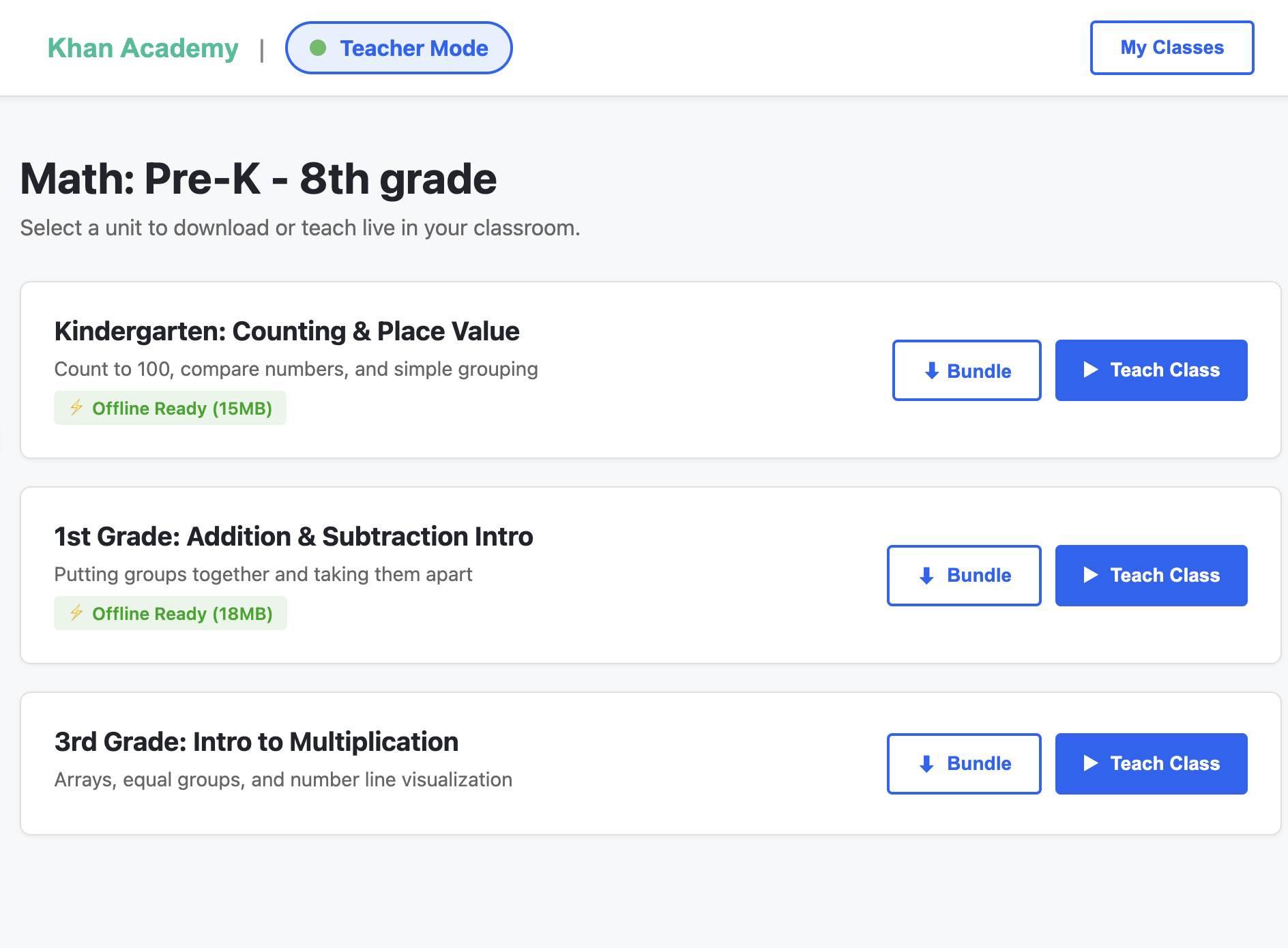
During my interview conversations, I proposed “Teacher Mode” - a one-device-to-many-learners solution designed for resource-constrained classrooms. The core insight: if personalization at the individual student level is impossible due to device constraints, can we create meaningful personalization at the class level?
The Teacher Mode Concept
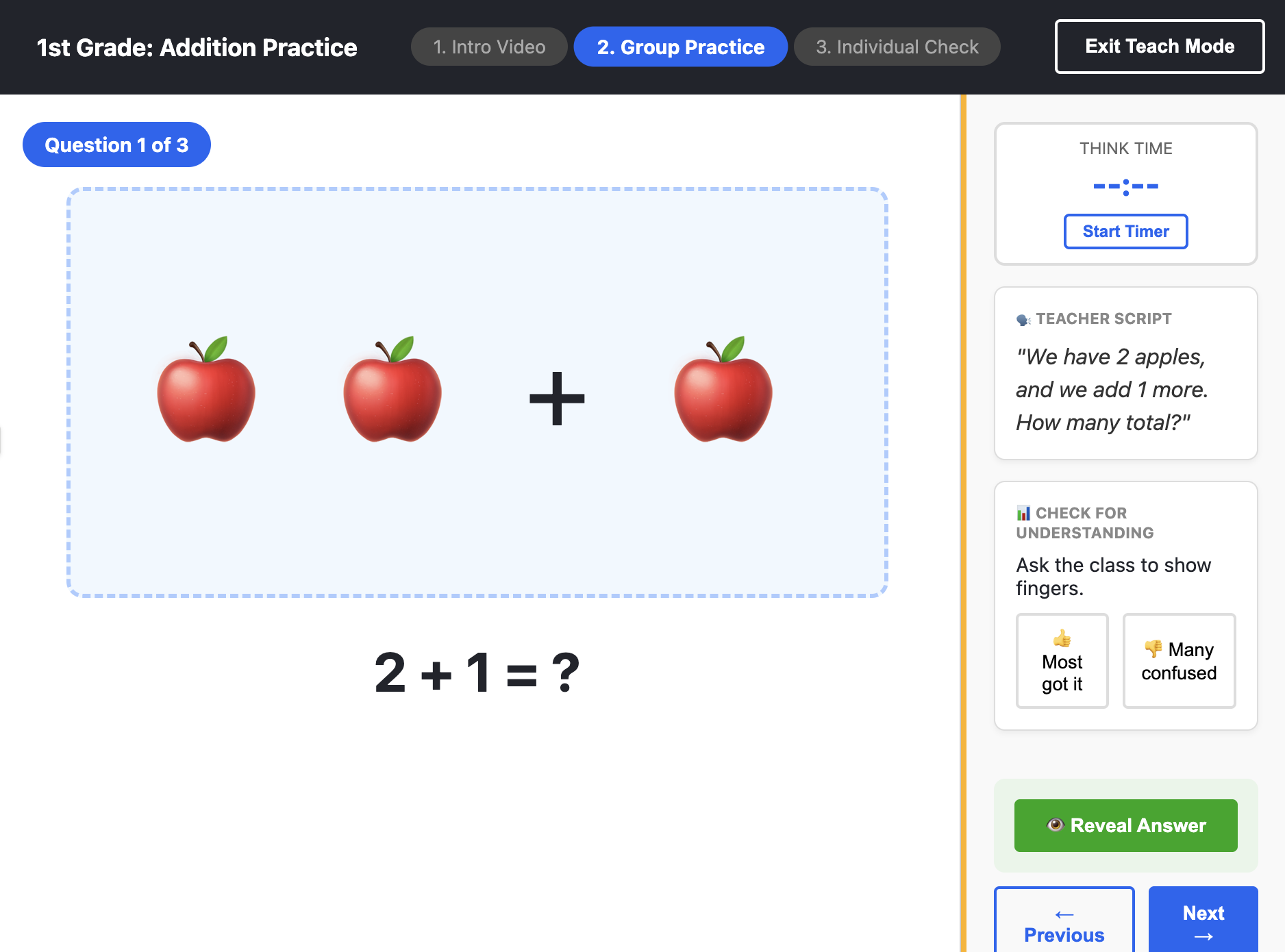
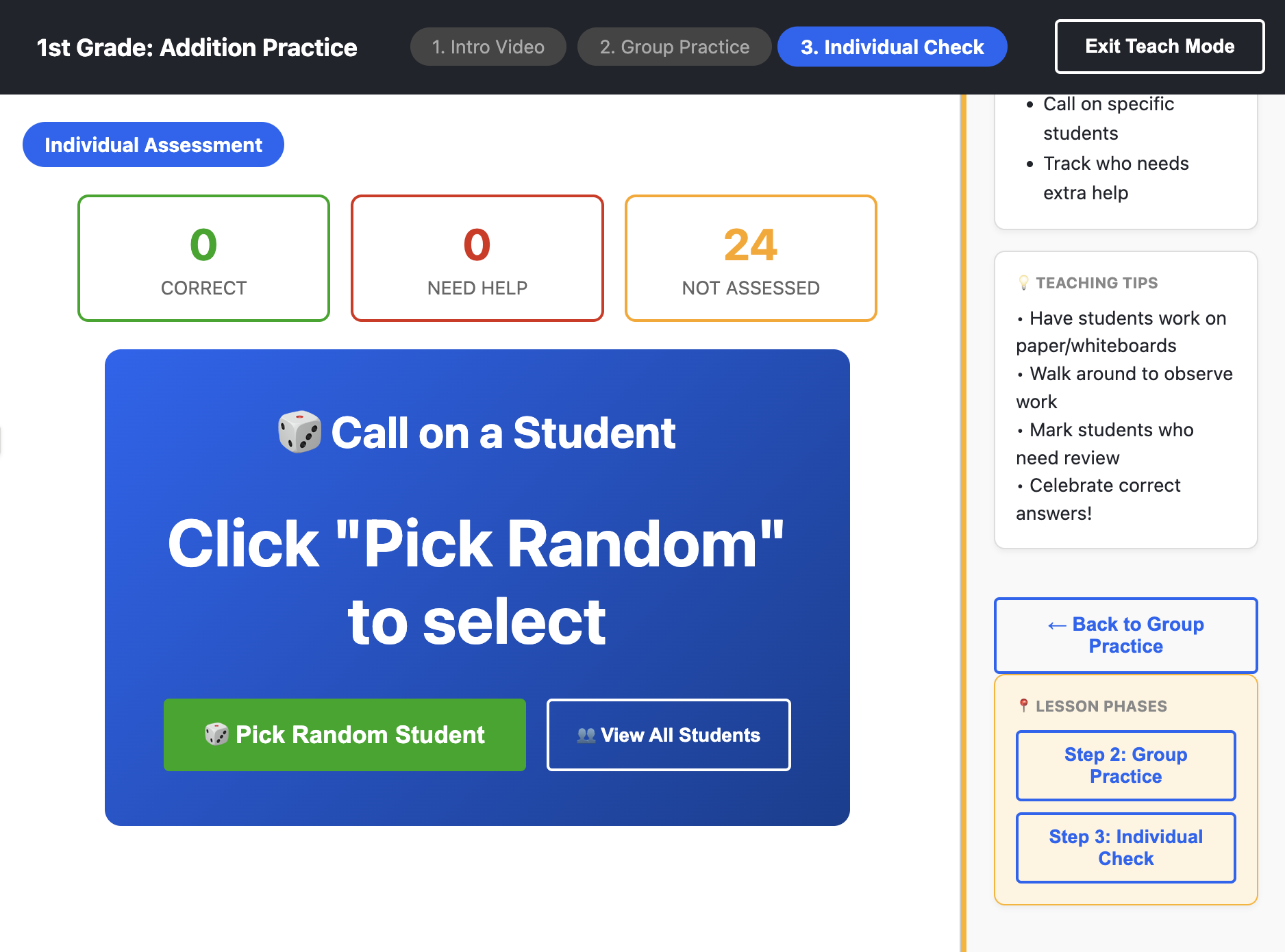
Core Workflow:
- Intro Video - Teacher shows Khan Academy video explaining concept to whole class
- Group Practice - Class works together on projected questions; teacher gauges collective understanding
- Individual Check - Students work independently on paper/slates while teacher circulates and tracks progress
Key Features:
- Projection-optimized interface (large visuals, minimal UI chrome)
- Teacher facilitation scaffolds (scripts, discussion prompts, pacing guidance)
- Class-level progress tracking (no individual student accounts required)
- Offline-first lesson bundles (<20MB, downloadable, sync when online)
- Random student picker and manual assessment tools for Individual Check phase
Why This Matters:
In a typical rural classroom in India, Pakistan, or the Philippines:
- The teacher has one smartphone or tablet
- 40-60 students sit on benches or the floor
- No individual devices
- Limited or no internet during class
- Students have slates, notebooks, or loose paper
Teacher Mode transforms that single device into a whole-class instructional engine, preserving Khan Academy’s pedagogical strengths (mastery-based learning, scaffolded practice, immediate feedback) while adapting to the reality of resource constraints.
The Grade 2 Learner Experience Gap
When reviewing Khan Academy’s current learner interface for early grades, I found a troubling disconnect. Here’s what a Grade 2 student sees when navigating the platform:
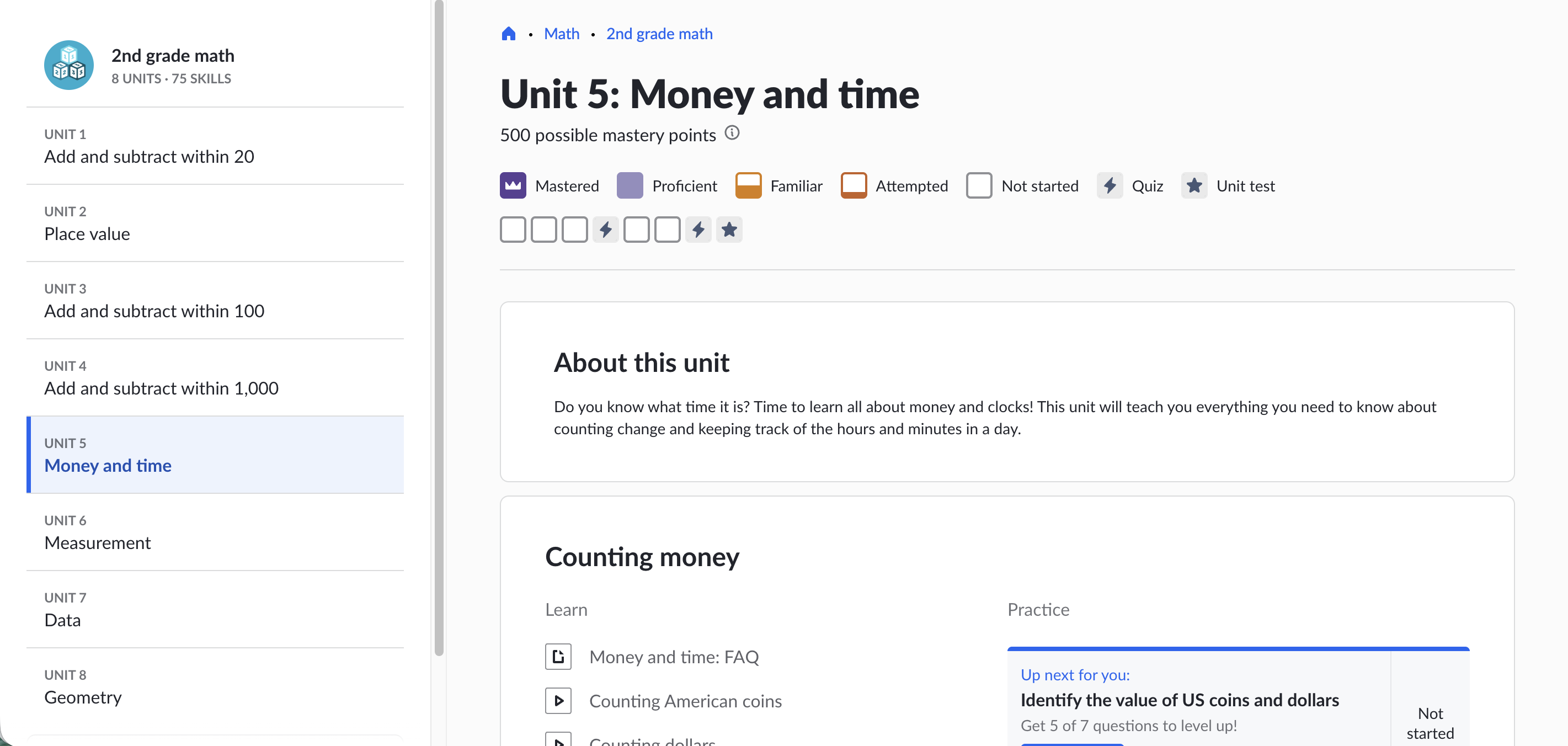
Problems with this design for 6-7 year olds:
- Text-heavy navigation (assumes reading fluency)
- Abstract concepts: “500 possible mastery points,” “Mastered,” “Practiced,” “Not started”
- Small click targets and dense information architecture
- Progress tracking metaphors (bars, percentages) that require cognitive abstraction
- No contextual scaffolding or visual anchors for non-readers
What I prototyped instead:
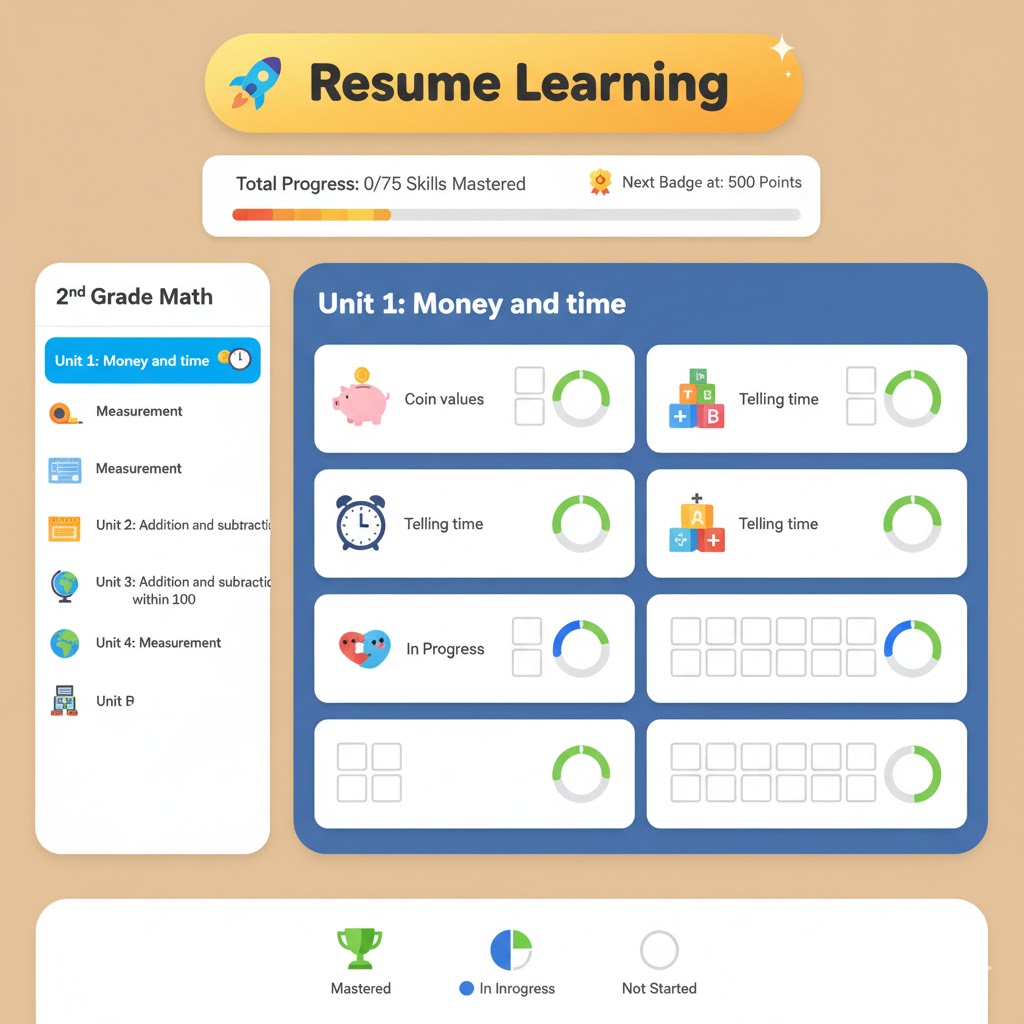
Key design changes:
- Visual-first navigation: Large, colorful icons for each topic (coins for money, clocks for time)
- Contextual progress: Visual completion indicators (e.g., partially filled circles) rather than abstract percentages
- Simplified hierarchy: “Resume Learning” prominently displayed, units shown as large cards
- Playful aesthetics: Badge/reward system visible and celebratory
- Minimal text: Icons and images carry meaning; text is supplementary
This isn’t about dumbing things down. It’s about cognitive load management and developmental appropriateness. A 6-year-old in rural Pakistan who is a first-generation learner needs a fundamentally different interface than a 12-year-old in suburban California.
The Global Reality: Common Patterns Across Developing Countries
Through my interview preparation, I conducted secondary research across multiple countries where Khan Academy operates or plans to expand. I analyzed:
- ASER India 2024 (Annual Status of Education Report - Rural)
- ASER Pakistan 2023
- EDCOM II Philippines (Year One Report on Education System Failure)
- Vietnam Education Data
- UNESCO Global Education Monitoring Report 2024/25
Eight Universal Patterns
1. Foundational Learning Crisis (Universal)
Across all countries:
- Massive gaps in reading & arithmetic
- India: Only ~23% of Grade 3 can read Grade 2 text
- Pakistan: Only 11-23% can read a story; 6-17% can do division
- Vietnam: Stronger overall but significant rural disparities
- Philippines: Foundational learning deficits are top national priority
- Learning-level diversity within same classroom
- Teachers cannot teach to grade-level textbooks
- 5-6 different learning levels in a single classroom
- No effective tools for differentiated instruction
2. Teacher Capacity Gaps (Universal)
All systems show:
- Weak preparation, especially in math & reading pedagogy
- Heavy administrative burden (Philippines: 68% of time; Pakistan: high absenteeism; Vietnam: excessive paperwork)
- Teaching quality is the #1 driver of student outcomes (GEM Report)
- Limited access to professional development
- No ongoing instructional coaching
3. Leadership Capacity Weakness (System + School Level)
GEM Report emphasizes:
- Leadership training globally insufficient
- Principals spend 70%+ time on operations vs. instructional leadership
- System leaders often untrained; high political turnover
- Fragmented governance and overcentralized processes
- Weak data-driven culture
- Poor assessment literacy across the system
4. Digital Inequity Despite High Smartphone Penetration
All countries show:
- Smartphones increasingly common (~60-80% of households)
- Laptops/tablets rare (<10% student access)
- Inconsistent bandwidth; unreliable electricity
- Students share devices across family members
- Urban-rural gaps persist and compound
5. Assessment Gaps Everywhere
All systems struggle with:
- No baseline/endline assessments
- No frequent formative checks during learning
- Exams disconnected from competency frameworks
- Teachers lack assessment literacy
- No actionable data at classroom or system level
6. Policy Shift Toward Competency-Based Curricula
All countries moving toward:
- Competency-based learning frameworks
- Flexible pathways and reduced rote memorization
- Standards-aligned frameworks (NEP India, Vietnam competency curriculum, Pakistan national standards)
- But implementation lags far behind policy
7. Demand for Cost-Efficient, Scalable, Proven Solutions
From all reports:
- Governments lack efficient data systems
- They seek scalable models (India’s NIPUN Bharat, Pakistan’s ASER partnerships, Vietnam’s EdTech push)
- Public spending on education declining globally (GEM Report)
- High demand for evidence-based, low-cost interventions
8. Increasing Community & Parent Involvement
Post-COVID shift:
- Parents more involved in children’s learning
- Community learning programs emerging (temple loudspeaker lessons in India, village tutors in Pakistan)
- Vietnam and Philippines strengthening community governance boards
- Opportunity for mobilization outside formal school systems
The Mission-Reality Gap: What Does “Anyone, Anywhere” Actually Mean?
Khan Academy’s mission statement is powerful and morally compelling. But missions must be operationalized - translated into concrete product decisions, partnership strategies, resource allocation, and success metrics.
Here’s where I see the gap:
Gap 1: Learning Outcomes vs. Life Outcomes
Khan Academy has strong evidence of improving learning outcomes:
- Increased mastery of math concepts
- Better test scores
- Improved confidence in STEM subjects
But the mission’s implicit promise is bigger: that education transforms lives. The next leap—from learning outcomes to life outcomes (college access, career readiness, income mobility, health, agency)—requires a fundamentally different approach.
Life outcomes require:
- Competency frameworks aligned with labor markets
- Employer partnerships and credentialing
- Career pathways and guidance systems
- Socio-emotional learning and soft skills
- Systemic interventions beyond content delivery
Khan Academy currently operates within existing educational systems rather than attempting to reshape them around evidence-based pathways from learning to livelihood.
Gap 2: Design Without Context = Subsidizing the Privileged
When you design for “anyone” without accounting for socioeconomic context:
- Device requirements favor those with resources
- Interface complexity assumes digital literacy and reading fluency
- Personalization features require individual sustained access
- The “world-class” experience becomes accessible primarily to the already-advantaged
This isn’t Khan Academy’s intent, but it may be the effect.
Gap 3: Stakeholder Alignment vs. User Needs
The interview response: “We need buy-in from governments and stakeholders” reveals a tension. Governments are important partners, but they’re not the end users. The students are.
When stakeholder needs (government visibility, donor reporting, partnership requirements) drive design decisions more than user needs (struggling readers, device-poor contexts, first-generation learners), mission drift occurs.
What Would Mission Alignment Look Like?
I don’t pretend to have all the answers. But based on my research and experience, here are directions that could strengthen alignment between Khan Academy’s mission and ground realities:
1. Explicitly Define “World-Class Education” Around Life Outcomes
Action:
- Establish a public theory of change from learning → competencies → opportunities → life outcomes
- Track and report on longitudinal outcomes: college enrollment, career placement, income data (where possible)
- Partner with employers, vocational programs, and colleges to create credentialed pathways
- Measure not just what students learn, but what they can do and where they go
2. Design for the Most Constrained Context First
Action:
- Make single-device, many-learner experiences (like Teacher Mode) core, not peripheral
- Offline-first by default; online as enhancement
- Design interfaces for non-readers and first-generation digital users
- Test all features in rural, low-connectivity, multi-grade classroom contexts before urban rollout
3. Embrace Class-Level Personalization
Action:
- Develop tools that help teachers manage learning-level diversity within a classroom
- Create “adaptive class sessions” that adjust difficulty based on aggregate performance
- Provide teachers with actionable, real-time insights on which students need intervention
- Enable formative assessment tools that work with paper-based student work
A Personal Reflection: The Burden of Ambitious Missions
I don’t write this from a place of superiority. I have shipped products that fell short of their promise. I have made design decisions that unintentionally excluded users. I have prioritized stakeholder demands over user needs.
Building transformative EdTech is extraordinarily hard. The challenges Khan Academy faces - sustainable funding, government bureaucracies, diverse learning contexts, technology constraints, content localization—are real and formidable.
But ambitious missions create high standards for accountability. When you promise “world-class education for anyone, anywhere,” you invite scrutiny not just of what you’ve achieved, but of whether your approach can fulfill that promise at scale.
My concern isn’t that Khan Academy hasn’t solved everything. It’s that the current trajectory focused on content expansion, individual personalization, and stakeholder partnerships may not be the path to reaching the “anyone, anywhere” the mission invokes.
The most marginalized learners—the ones who need “world-class education” most desperately—aren’t being designed for. They are being designed around.
An Open Letter to Sal Khan
If this reaches you, Sal, here’s what I hope you’ll consider:
Your mission is extraordinary. It inspired me. It inspired millions. The work Khan Academy has done to democratize access to knowledge is genuinely transformative for many learners.
But there’s a gap—a widening gap—between the mission’s promise and the reality on the ground in resource-constrained communities. I am not suggesting you abandon what’s working. I am suggesting you expand the definition of what’s possible.
What if Khan Academy:
- Led the EdTech sector in designing for device-constrained classrooms?
- Proved that class-level personalization could match individual personalization in impact?
- Published transparent, longitudinal data on life outcomes, not just learning gains?
- Measured success not by total users, but by users in the bottom socioeconomic quintile?
- Shaped government education systems instead of just operating within them?
Your platform, brand, reach, and resources position Khan Academy uniquely to do this. No other EdTech organization has the credibility, scale, and mission clarity to set new standards for equity-centered design.
The world doesn’t need another platform optimized for students who already have access. It needs tools that work for the students left behind by every other system.
That’s the “anywhere” that matters most.
Conclusion: Mission as Compass, Reality as Map
I didn’t get the job at Khan Academy, and perhaps that’s for the best. But the process clarified something important for me: the most dangerous thing in mission-driven work is assuming your mission is self-implementing.
Missions are compasses. They point toward true north. But you still need a map of the actual terrain. And if the terrain is full of obstacles you’re not designing for, the compass alone won’t get you there.
Khan Academy has a powerful compass. The question is whether it will build the maps, tools, and pathways needed to reach the places its mission points toward.
I hope it does. The world needs it to.
Postscript: I sent a version of these reflections to the Khan Academy recruiter after my interview process concluded.
This article reflects my personal views developed through independent research and interview preparation. It does not represent the positions of any organization I’ve worked for, including Axway, Carnegie Learning, or Toppr.
References & Sources
- Khan Academy 2024 Annual Report
- Khan Academy IRS Form 990 (FY 2024)
- Annual Status of Education Report (ASER) India 2024
- ASER Pakistan 2023
- EDCOM II Philippines: Year One Report on Education System Failure
- UNESCO Global Education Monitoring Report 2024/25
- World Bank: From Learning to Life Outcomes Framework
